
Cedar Tree (Cedrus)
- Date: 19/Mar/2026
- Comments: 4
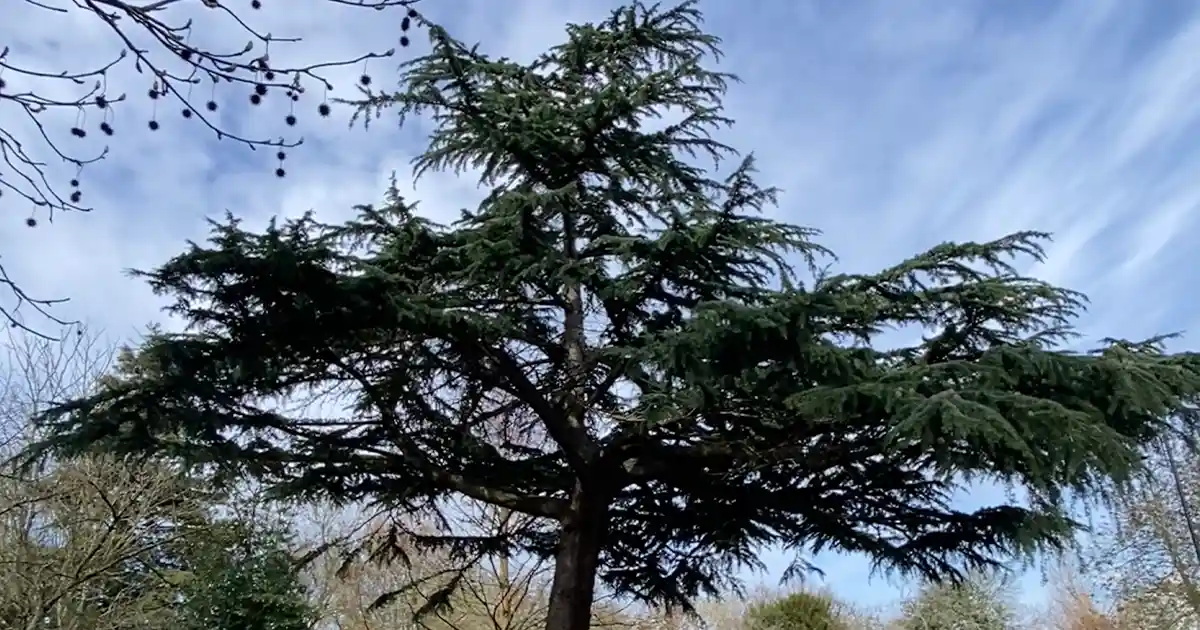
Few conifers command the UK skyline quite like a mature cedar tree. If you have ever walked through a sprawling British estate or a large public park, you have likely stood beneath the massive, tiered canopy of a Cedar tree. While Cedars are not native to the UK, they have become an iconic part of our historic landscape.
Whether you are trying to identify a towering evergreen on your property or you are considering planting a cedar sapling, here is a complete guide to the species from a professional arborist’s perspective.
Cedar Tree Taxonomy
Before examining the specific traits, it helps to understand the tree’s basic taxonomy. While you might hear the term “cedar” applied to many different evergreens, true cedars are quite rare.
Common Names: Cedar, Lebanese cedar, Cedar of Lebanon.
Scientific Name: Cedrus (The most iconic being Cedrus libani).
Family: Pinaceae.
Genus: There are exactly four recognised species within the true Cedrus genus worldwide: the Cedar of Lebanon (C. libani), the Atlas Cedar (C. atlantica), the Deodar Cedar (C. deodara), and the Cyprus Cedar (C. brevifolia).
Origin: Non-native to the UK. True cedars originate from the western Himalayas and the Mediterranean basin, with the Cedar of Lebanon heavily concentrated in mountainous regions across Lebanon, Syria, and Turkey.
Types of Cedar Trees in the UK
While there are four true species globally, you will predominantly encounter three main types of cedar trees in the UK. Because they share the same genus, they have similar care requirements, but they possess distinctly different growth habits and foliage.
Cedar of Lebanon (Cedrus libani)
The undisputed heavyweight of British estates. As mentioned, this type of cedar tree is famous for its massive, horizontal, tiered branches and flat-topped crown when fully mature. It features dark grey-green foliage and remains the most historically significant cedar variety in the UK landscape.
Atlas Cedar (Cedrus atlantica)
Originating in the Atlas Mountains of Morocco, this cedar grows with a more upright, conical shape and ascending branches, unlike the the Cedar of Lebanon. In the UK, you will most frequently spot the striking Blue Atlas Cedar tree (Cedrus atlantica ‘Glauca’), which is highly prized by landscapers for its vibrant, silvery-blue needles.
Deodar Cedar (Cedrus deodara)
Native to the Himalayas, the Deodar is easily distinguished by its drooping, weeping leader and branch tips. It features longer, softer needles that are a much lighter green. If you are searching to identify a “weeping cedar tree” in the UK, it is almost certainly a Deodar Cedar.
What Does a Cedar Look Like?
Identifying cedar trees is straightforward once you recognise their key growth habits. Interestingly, the tree’s branches adapt to its environment; in a dense forest, the branches grow straight and narrow, but in wide-open spaces, the tree develops its signature broad, spreading canopy with horizontal tiers.
Size and Scale: The Cedar of Lebanon is a truly monumental tree. A mature specimen can reach up to 130 feet (40 metres) in height, with a trunk diameter spanning over 6 feet (2 metres).
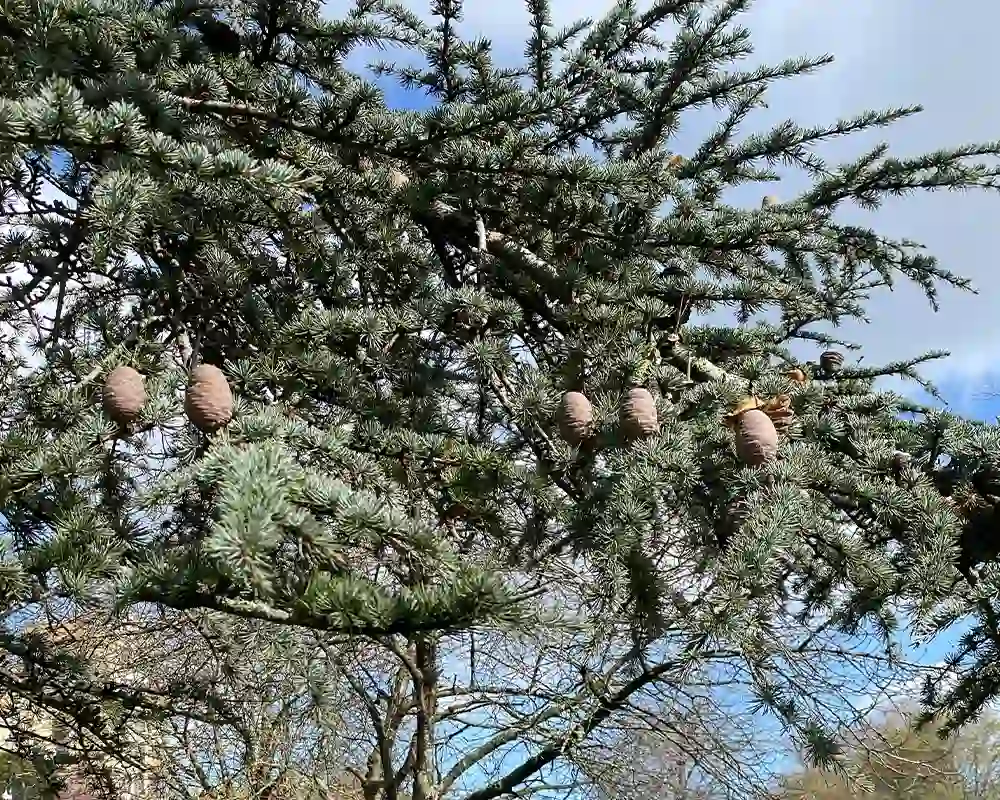
Cedar Tree Leaves: Unlike broadleaf trees, cedars feature short, dark green needles that grow in distinctive tufts or rosettes along the short, spur-like side shoots.
Cedar Bark: On young cedar saplings, the bark is fairly smooth, and the tree holds a conical shape. As the tree matures and develops its flat crown, the bark turns a greyish-brown and develops deep grooves and rough fissures.
Cedar Tree Cones & Reproduction: The tree is a late bloomer, typically not “flowering” or producing cones until it reaches 30 to 40 years of age. It produces two-inch unisex catkins. The resulting female cones are light green, barrel-shaped, and sit completely upright on the branches. Each cone scale houses two winged seeds that ripen between August and October, after which the cone breaks apart, releasing them into the wind.
Cedar Tree Planting & Growing Conditions
If you are looking at cedar trees for sale, it is essential to understand their specific space and soil requirements before planting.
A cedar sapling needs a spacious, isolated location well away from buildings to accommodate its future root spread and massive canopy. They require full light for optimal growth. While they thrive in well-draining, acidic soil, they are highly adaptable and will successfully establish themselves in alkaline, clay, or chalky soils, provided the drainage is sufficient.
When planting, dig a hole three times wider than the container your cedar arrived in, ensuring it is as deep as the root ball. Carefully remove the tree without disturbing the soil around the roots, place it centrally, and backfill. Create a shallow soil basin around the base to retain water. During its first year, especially in hot and dry weather, water the tree thoroughly every 10 days to help it establish. Once settled, they are incredibly hardy trees that require very little ongoing care or pruning.
If you require assistance with sourcing, planting, or pruning a Cedar tree, contact us here at GraftinGardeners Ltd today. We have a wealth of arboricultural expertise, and our services are available throughout Greater London.
Cedar Ecology & Habitat
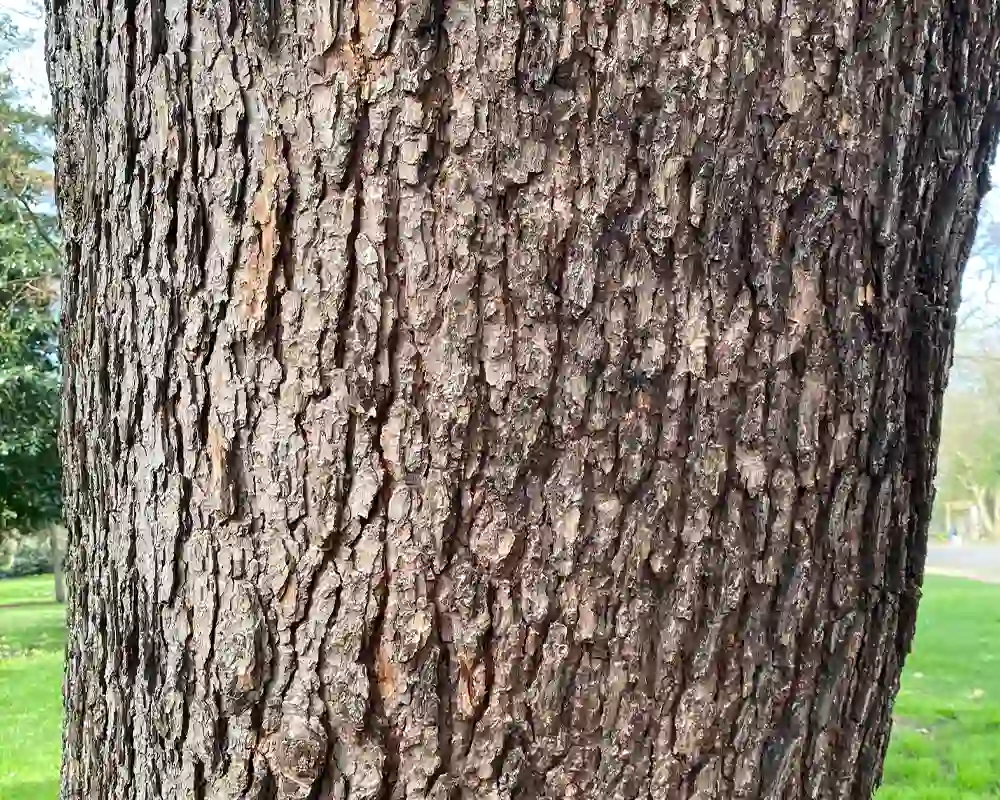
Because true cedars were imported and are not native, you won’t find wild cedar forests in the UK. Instead, they thrive in large, open spaces such as historic manors, expansive cemeteries, and public parks. Despite being non-native imports, British cedars offer excellent value to our local wildlife. The deep, rough grooves in mature cedar bark create ideal micro-habitats for invertebrates. Furthermore, their substantial, sturdy branches provide excellent nesting sites for birds of prey, while the cavities in older, decaying specimens serve as important roosting spots for local bat populations.
Cultural Context, History & Uses of Cedar Wood
The cedar tree is heavily anchored in history, often associated with protection, longevity, and biblical references.
Historically, the Lebanese cedar produced timber so massive and durable that it became the go-to material for ancient temples and naval fleets. Fast forward to today, and we still value cedar wood for its distinct, spicy aroma. Because the timber is rich in natural oils, it resists rot and insect attack, which is exactly why cedar wood is used as a natural clothes-moth repellent in wardrobes.
The Cedar of Lebanon actually arrived in the UK roughly 400 years ago. From the 1740s onwards, it turned into an absolute must-have for the British aristocracy, planted across grand estates as a towering symbol of wealth.
Cedar Threats & Diseases
Cedars are generally resilient and not highly prone to pests, but they are susceptible to a few specific issues in the UK climate, as highlighted below.
Sirococcus Blight
Caused by the fungus Sirococcus tsugae, this pathogen turns the needles a highly distinctive pink before they die and drop off. It leads to shoot dieback and causes the bark to ooze a gummy, resinous fluid.
Honey Fungus
An aggressive root rot that sweeps through the soil and can prove fatal to even mature cedars if their immune systems are compromised.
Aphids
The cedar aphid feeds on sap, causing the foliage to thin and turn brown, often leaving a sticky honeydew residue on the lower branches.
Interesting Facts About Cedar Trees
The Flag of Lebanon Tree: The cedar is the national emblem of Lebanon, prominently featured in the centre of the country’s flag and coat of arms.
The Oldest UK Cedar: The oldest recorded cedar tree in Britain was planted in 1646 by Dr Edward Pocock in his rectory garden near Wantage, Oxfordshire.
UNESCO World Heritage Status: In 1998, the “Cedars of God” (Horsh Arz el-Rab), a remnant of antique cedar forests located on Mount Makmel in the Qadisha Valley of northern Lebanon, was designated a UNESCO World Heritage Site.
Ancient Lifespans: The Lebanon cedar is exceptionally slow-growing, and some of the surviving trees in their native mountainous habitats are believed to be over 1,000 years old.
Article was written by Peter Arnold.
Article Source: https://www.graftingardeners.co.uk/cedar-tree/





















4 comments on “Cedar Tree (Cedrus)”
I am learning about these trees and I think it’s amazing I would love to get more info and a tour if possible. Also interested in buying one once I get a place for sure
Hello! If you come to Lebanon I am a local from the Cedars of Bcharre area and an educational guide of the Cedars of God and its surrounding waterways.
If you would like Dm me and we can arrange a guided tour.
Save Welwyn Ancient Cedar of Lebanon
The Woodland Trust has asked for an extension from planning so that they can respond.
Welwyn Parish Council has asked the tree officer to carefully examine this tree as they would like to see it saved.
A member of the Welwyn Parish Amenity Group said they fully support our efforts to prevent this from happening.
This veteran, possibly ancient tree is of significant cultural and heritage value to the village and local community. The very age, size and decay provide an immeasurable level of biodiversity habitat.
Let’s hope that planning and the owners will now take the time to investigate all other options seriously to protect and preserve it.
There’s still time for you to add your name here: https://l.facebook.com/l.php?u=https%3A%2F%2Fwww.petitions.net%2Fsave_the_cedar_tree_at_the_guessens_welwyn_planted_between_1730-1765%3Ffbclid%3DIwZXh0bgNhZW0CMTAAAR2r7ronJyE_Aj-97_DJ1p_p14AZ0M-CWFeV_sgxJXmvtreXN8jL2rPah8o_aem_Ht1MMeW1Ljxq7V5xDpkpng&h=AT21-941x7o_MFF_capJf1yi3M7nC1TxnlTxyWeLk6KuUYT1usuRQfZXPJBa4ILUyxA490pPeE7X4QbS0u4La3FUbFihZ5y8Si6cNB49sdE1qCE–dDMsGWC_QrtfYVvCol2O3mo4cr7eOYuPQ&__tn__=-UK-R&c%5B0%5D=AT2pQdo3tqr9G5QB0CMnPoj7b06TmmK_odHrz81BpNw_lGLIbl34bR3CvszQqdJAWPbAgG8FMnGkm21c84R_xRZ-hyuKjU27BjSCsTZaowyOiVcgrFZEQPVdJ_2aLgTfl40RlnDix3CL9CIFabUUKk7kK_oQbw6LJcY2rI8rvsjPTNBACI30pYXuaclKB7Hc
READ THE BIBLE FOUND IT THEN WANTED TO EXPLORE MORE ABOUT IT .. ANYWA WILL HAVE IT AT MY OWN HOUSE ONE DAY,, FEEL LIKE ITS NICE AND SWEET IN LOOKING