BS 5837 Tree Survey And Landscape Plan
We have highly certified tree consultants who provide professional BS 5837 Tree Surveys, Arboricultural Impact Assessments (AIA) and Landscape Plans across London, from £460. Our arboricultural consultants have extensive experience in dealing with local planning authorities and are well-versed in what they are likely to approve or reject.
Need a quickly turned-around BS5837 survey for a planning application? Call 0208 123 7653 or request a fixed-price quote.
When Do You Need a BS5837 Tree Survey in London?
Your local planning authority will require a BS5837 tree survey with your application if trees stand on or within influencing distance of your site. In practice, that means:
- Extensions, lofts and outbuildings where any tree over 75mm stem diameter stands within 12 metres of the works
- New builds and developments of any size where trees are on or adjacent to the site
- Demolition and change of access near trees
- Applications in Conservation Areas or involving TPO trees, where boroughs scrutinise tree information closely
If your architect or the council has asked for a "tree report for planning", an "arboricultural report" or a "tree constraints plan", this is the survey they mean. We prepare all of it to BS5837:2012, Trees in Relation to Design, Demolition and Construction, for homeowners, architects, developers and planning consultants alike. If you need a survey for safety or duty of care rather than planning, see our tree safety reports instead.
What is the difference between a BS 5837 Tree Survey, Arboricultural Impact Assessment (AIA) and a Landscape Plan?
A BS 5837 Tree Survey evaluates trees on a site, an Arboricultural Impact Assessment (AIA) assesses how a development affects those trees and proposes mitigation, and a Landscape Plan details the planting and existing features for the new development. They work together sequentially. The survey identifies and gathers data, the AIA analyses the impact of the proposed development on those trees, and the landscape plan then incorporates the retained trees, proposed planting and other hard and soft landscaping elements into a cohesive site plan.
What is a BS 5837 Tree Survey?
Purpose: to identify, map and evaluate the condition, quality and longevity of trees on and adjacent to a development site.
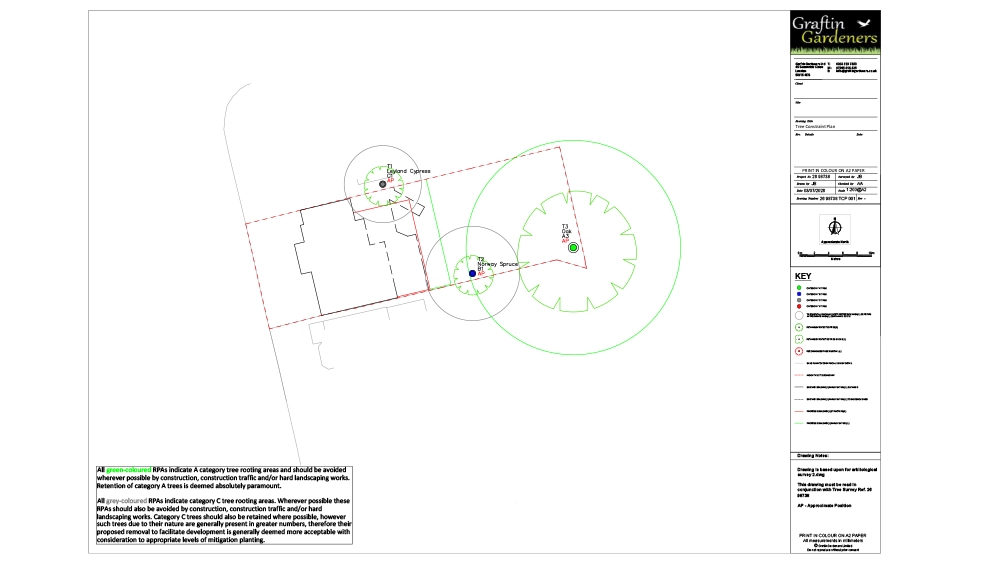
Outputs: a Tree Constraints Plan (TCP), which maps the trees, crown spreads and their Root Protection Areas (RPAs), and a Tree Schedule that categorises each tree (A, B, C or U) based on its quality and potential to remain on the site. A, B and C trees are worth keeping, with A being the highest value, while U trees are unsuitable for retention.
Key information: the survey provides the fundamental data on existing trees that informs the next stage of the planning and design process, the AIA.
What is an Arboricultural Impact Assessment (AIA)?
Purpose: to assess the impact of the proposed development on the trees identified in the BS 5837 survey.
Outputs: an explanation of which trees are to be removed, retained or pruned, an analysis of potential effects on tree root systems and crown spread, and a summary of tree removal and pruning works.
Key information: the AIA bridges the gap between the existing trees and the proposed development by identifying conflicts and proposing solutions, such as tree protection measures.
What is a Landscape Plan?
Purpose: to detail the proposed landscaping for the development, including the design of hard and soft features, and to integrate retained trees into the overall site plan.
Outputs: a detailed drawing showing the final design for the site including buildings and other features, the location of existing trees to be retained, and proposed new planting of trees, shrubs and other plants.
Key information: the landscape plan visualises how the retained trees, new planting and built environment will interact to create the final landscape.
How They Work Together
The BS 5837 Tree Survey provides the baseline data on the existing trees. Our consultants use that data to create the Tree Constraints Plan, which shows the RPAs and other tree limitations that influence the initial site layout and building design. The Arboricultural Impact Assessment then evaluates how the proposed development will affect the trees, and its findings, including which trees will be removed or protected, are incorporated into the Landscape Plan. The result is a consistent set of documents that protects trees throughout the entire development process and gives the council everything it needs to approve.
How Much Does a BS5837 Tree Survey Cost in London?
BS5837 tree surveys start from £460, with the final fixed price depending on the number of trees, the size of the site and whether your application also needs an Arboricultural Impact Assessment, landscape plan, tree protection plan or method statement. Every quote is a fixed written price agreed before we start. See our full London tree surgery price guide for typical costs across all services.
Our BS5837 Survey Process
- Send us your site details and, if you have them, architect's drawings. A DWG or PDF site plan speeds things up, but we can work without one.
- We survey the site, plotting every relevant tree, its category (A, B, C or U), crown spread and root protection area.
- You receive your report, including the tree schedule and Tree Constraints Plan, usually within days, ready to submit with your application.
- If the council requires more, we prepare the Arboricultural Impact Assessment, landscape plan, tree protection plan and method statement, and we liaise directly with your architect and the borough's tree officer so retained trees and new planting are properly integrated into the final design.
We work with London borough planning departments and London tree officers week in, week out, so our reports are written to be approved, not queried. Explore our full range of tree surveying services.
Here is a downloadable PDF example of a BS5837 tree survey report we prepared for a London planning application, with client details redacted, so you can see exactly what your council will receive.
Frequently Asked Questions
Do I need a BS5837 tree survey for an extension?
If any tree with a stem diameter over 75mm stands within about 12 metres of the proposed works, your council will almost certainly require one with your planning application. Check with your borough, or send us your plans and we will tell you.
How long does a BS5837 survey take?
The site visit typically takes a few hours. Reports are usually delivered within days of the survey, depending on site size and whether an AIA is also required.
How much does a BS5837 tree survey cost?
From £460 in London, quoted as a fixed written price based on the number of trees and the site. An Arboricultural Impact Assessment or tree protection plan, where required, is quoted alongside.
Do I need a landscape plan as well as a BS5837 survey?
Often, yes. Many London boroughs require a landscape plan with planning applications, showing how retained trees, proposed planting and the built development fit together. We prepare landscape plans alongside our BS5837 surveys and AIAs so everything arrives consistent and ready to submit.
What happens if my trees are protected?
TPO and Conservation Area status is checked as part of the survey. Protected trees can still be incorporated into a development, and where works to them are needed, we prepare and submit the council application for you.
Can you also do the tree work the report recommends?
Yes. We are a full tree surgery company, so the same NPTC-qualified, £10m-insured team that surveys your site can carry out any approved felling, pruning or protection works to BS3998. The survey itself is always impartial. Trees are categorised strictly to the BS5837 standard, and we never recommend removals a scheme does not require.
Book Your BS5837 Tree Survey in London
Call 0208 123 7653 or request a free quote today. Send your site plans over and we will confirm exactly what your borough will require.