Dangerous Ash Tree Made Safe in Wimbledon, Left as a 7 m Habitat Monolith
- Date: 31/Oct/2026
- Comments: 0
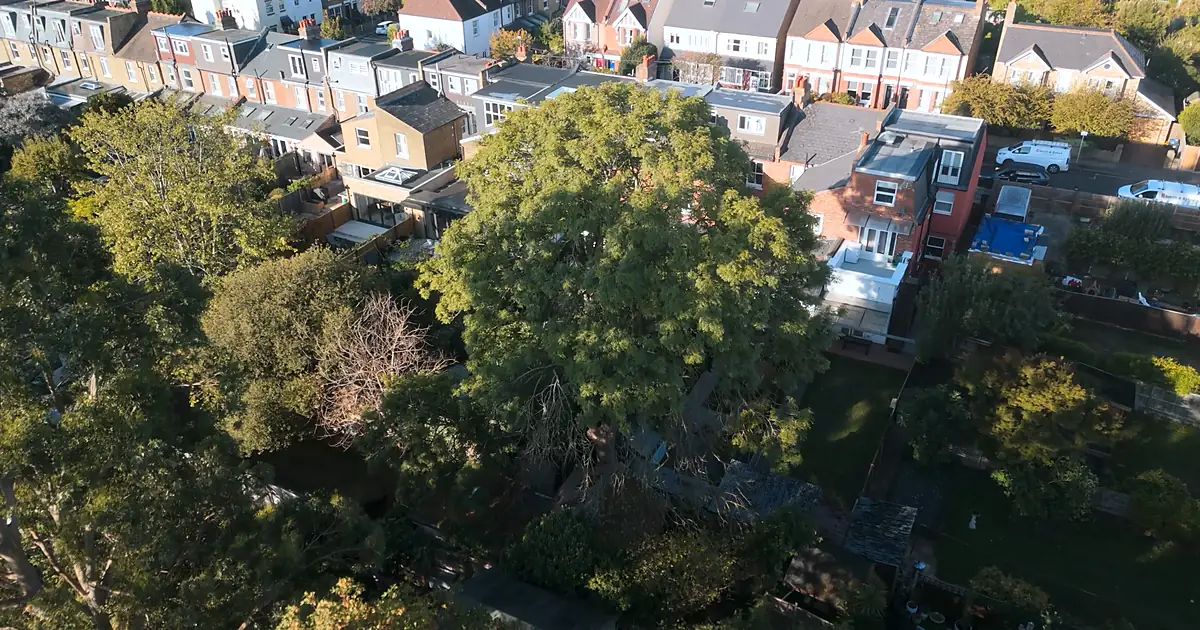
In the middle of September our team spent a day in a back garden in Wimbledon, SW19, taking down most of a large ash tree that had become dangerous. The tree is still there. What was a crown spreading over five neighbouring gardens is now a 7 m standing stem, a living tree with the risk taken out of it. This is how the job went, with the video our videographer shot on the day.
The Dangerous Ash Tree Project at a Glance
- Where: a terraced back garden in Wimbledon, SW19, London Borough of Merton
- Tree: a large mature common ash (Fraxinus excelsior) with a cavity in the main stem
- Problem: structurally unsound at full height, with the crown over five gardens and their sheds
- Work: sectional dismantle on ropes, reduced to a 7 m habitat monolith, plus access pruning
- Team: one lead climber, a team leader and three groundsmen
- Time on site: one day
- Waste: chipped for biomass and cut for firewood at our Surrey (Leatherhead) depot, nothing to landfill
Why the Tree Could Not Stay at Full Height
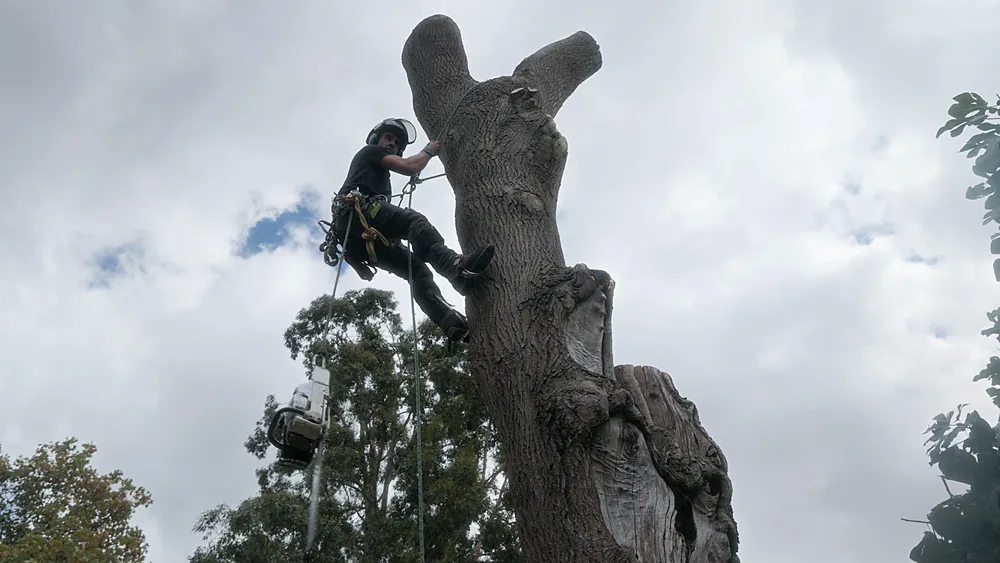
Ash gets most of its attention for ash dieback these days, but the problem with this one was structural. The main stem had a cavity, which you can see clearly at 1:28 in the video when the climber is working beside it. A hollow of that size in the trunk means the tree is carrying a full crown on a lot less sound wood than it looks, and a decayed ash gives very little warning before it fails. There were no fungal brackets on the stem, and the crown was in leaf and growing, so this was a living tree with a weak point, not a dying one.
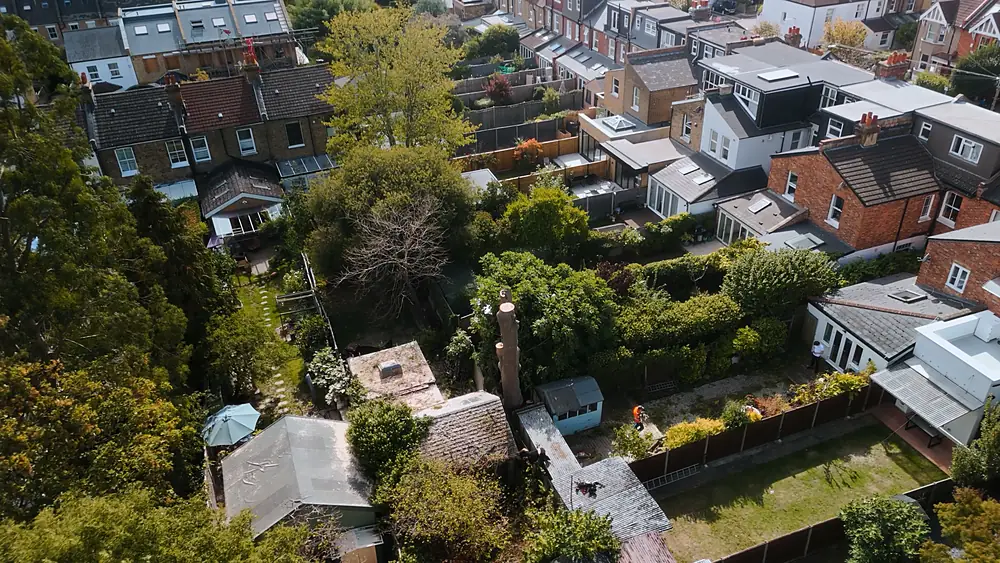
The setting made the risk worse. The ash stood in the corner of a small garden with the crown spread across five neighbouring plots, their sheds and fences underneath it, and terraced houses on every side. If a limb or the stem let go, there was nowhere for it to land that did not belong to somebody.
Why a Monolith Rather Than a Full Removal
The client’s wish was to keep as much of the tree as could safely stay. Ash responds well to being cut hard and usually pushes out new growth from the remaining stem, so the plan was to reduce the tree to the maximum safe height and let it reshoot. The final height can only be judged once a tree is being dismantled and the stem is open to inspection, and on the day that came out at about 7 m.
What is left is a habitat monolith: a tall standing stem with a cavity in it, which is exactly the kind of feature that bats, nesting birds and wood-boring invertebrates use. The garden keeps a tree, the neighbours lose the thing that was hanging over their sheds, and nothing had to be ground out or replanted.
Checking Whether the Tree Was Protected
Before quoting any work like this we check whether a tree has a Tree Preservation Order or sits in a conservation area, because either one means an application to the council before a saw is started. We checked with the London Borough of Merton. This ash had no TPO and the garden is outside any conservation area, so no application was needed. If it had been protected, we would have made the application for the client, as we do on protected trees across Wimbledon and Merton. There is more on how that works on our conservation areas page.
The Dismantle: Five Gardens and One Narrow Alley
There was no straight fell available here. The only way into the garden was a narrow side alley, and the only way down for the crown was in pieces. Our lead climber worked up through the tree on ropes, taking the crown off limb by limb from the outside in, while the team leader ran the lowering kit from the ground. Every section was rigged, lowered under control and landed where the groundsmen could reach it, including on to the shed roofs next door, which you can see at 0:24 and 1:05 in the video.
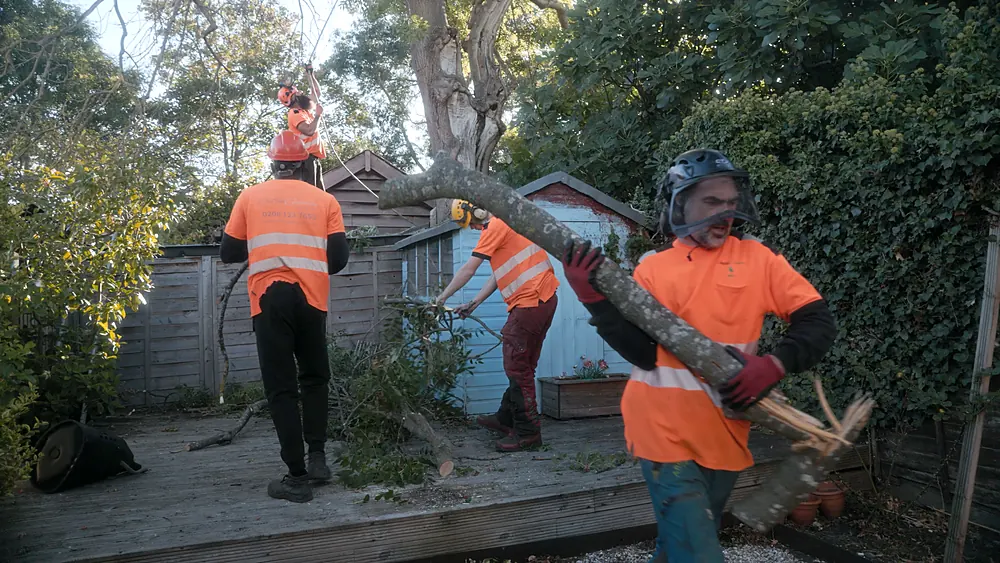
Because the crown overhung five gardens, we spoke to every neighbour beforehand, so people knew when we would be working over their fence and could move furniture and anything else out from under it. Three groundsmen carried the brash and timber down the alley to the street, where the chipper and truck were parked, and the team leader kept the lowering lines and the alley moving. Five of us, one day, and the garden was clear by the evening.
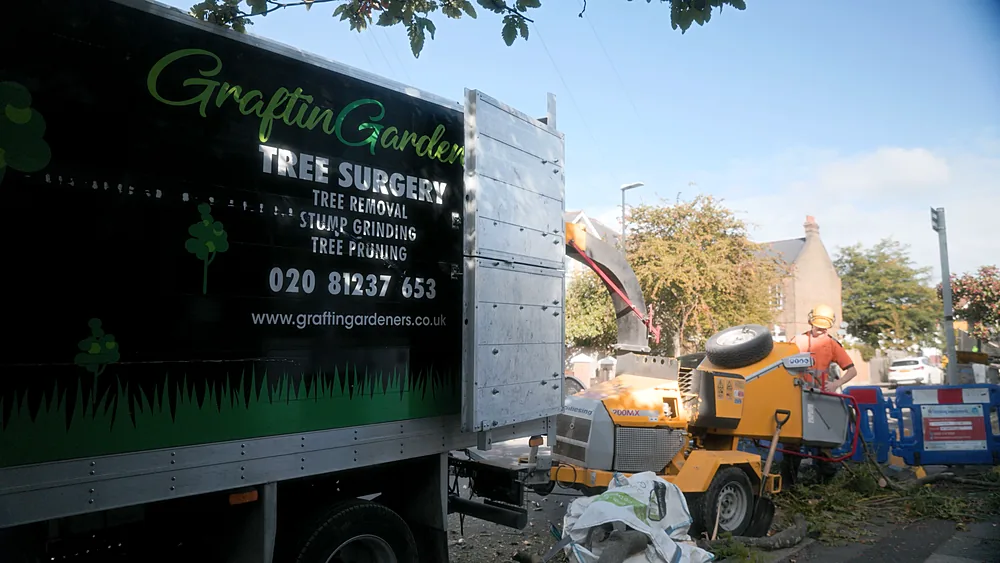
All of the work was carried out to our usual felling and dismantling standards under BS 3998:2010, the British Standard for tree work. While the kit was on site we also cut back the neighbouring trees that were crowding the alley and the garden, reduced a fig by roughly a third and coppiced a hazel, all at the client’s request, which gave the team room to work and the client more usable garden.
Where the Tree Went
Nothing from this job went to landfill. The brash and the smaller branches were chipped on the street and taken to our green waste recycling centre in Surrey (Leatherhead), where the chip is dried into biomass wood chip. The larger timber went to the same yard to be cut into logs and cordwood for firewood, and the pieces that were too far gone for that were chipped too.
Ash is one of the best firewoods there is. It has a low moisture content even when freshly felled, splits cleanly and burns at a steady rate, which is why the old rhyme has a king warming his slippers by it. A tree that had to come down over five Wimbledon gardens will be heating homes this winter.
The Result
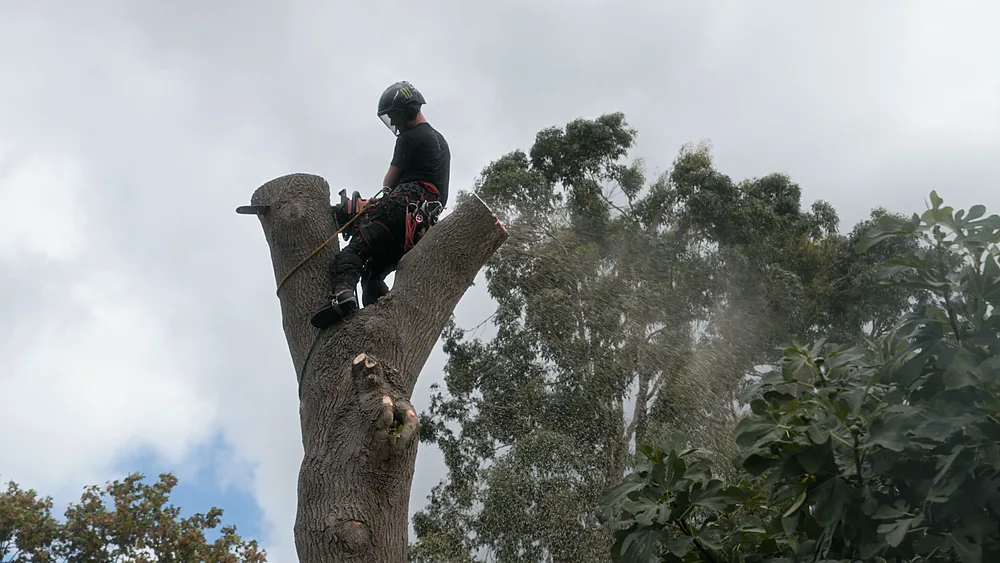
A 7 m ash monolith standing in the corner of the garden, the sheds and fences around it untouched, five gardens with sky above them again, and a tree that should be in leaf next summer. The client emailed us that evening:
“Thank you for the work completed today; I am very happy with the result.”
Worried About an Ash Tree in Your Garden?
A large ash in a small London garden is worth looking at properly every few years, and sooner if you can see a cavity, fungal brackets at the base, dead wood in the crown, or the thinning and dieback at the branch tips that ash shows when it is struggling. If the tree stands over your neighbours, a tree safety report puts its condition and your options in writing, and if it needs work, a monolith, a reduction or a full dismantle can all be quoted on the same visit.
We work across Wimbledon, Merton and the whole of London and Surrey as London tree surgeons with NPTC-qualified climbers, £10m public liability insurance and over 1,000 five-star reviews. Call 0208 123 7653 or request a free quote.
Frequently Asked Questions
What is a habitat monolith?
A habitat monolith is a tree that has had its crown removed and been left as a tall standing stem, usually several metres high, rather than being felled to the ground. It keeps the habitat value of the trunk, including any cavities, for bats, birds, fungi and invertebrates, while removing the weight and spread that made the tree a risk. In this Wimbledon job the monolith was left at about 7 m.
Will an ash tree regrow after being reduced to a stem?
Usually, yes. Ash reshoots readily from the remaining stem, which is why it has been pollarded and coppiced for centuries. The regrowth needs to be managed every few years so it does not become top-heavy, but a monolith cut from a living ash will normally be in leaf again the following summer.
Do you need council permission to take down a dangerous tree?
It depends on whether the tree is protected. If it has a Tree Preservation Order or stands in a conservation area, an application or notice to the council is needed before work starts, with a narrower exception for trees that are an immediate danger. We check the register with the local council before quoting and handle the application where one is needed. The Wimbledon ash in this case study was not protected, so no application was required.
How long does it take to dismantle a large tree in a small garden?
A large ash over neighbouring gardens with no vehicle access is typically a one-day job for a crew of four or five, as it was here. The crown comes down in sections on ropes, and most of the day goes on lowering each piece safely and carrying the arisings out to the chipper rather than on the cutting itself.
Why not fell the tree in one piece?
Straight felling needs a clear landing area longer than the tree is tall. In a terraced back garden with sheds, fences and other people’s property on every side, that does not exist, so the tree has to come down in pieces that are lowered under control. It takes longer and needs rigging kit and an experienced climber, but it is the only safe way to do it.
Article was written by Adam Rybinski · Company Director · GraftinGardeners Ltd · Published October 2026
Article Source: https://www.graftingardeners.co.uk/dangerous-ash-tree-wimbledon/