UK Drought Effects on Trees (2026)
- Date: 27/Aug/2026
- Comments: 0
England has just recorded its driest July since records began 190 years ago, with barely 10 percent of the rainfall it would normally get. Half the country was officially declared in drought on 29 July, and by mid August that had spread to over two-thirds of England along with the whole of Wales. Hosepipe bans now cover more than 27 million people, and this is the third drought in five years.
You can already see it in the trees. Browning crowns in high summer, leaves drifting across pavements a season early, and limbs coming down on still, windless days. Here is what the drought is actually doing to your trees, which warning signs matter, and what is worth doing before the autumn storms arrive.
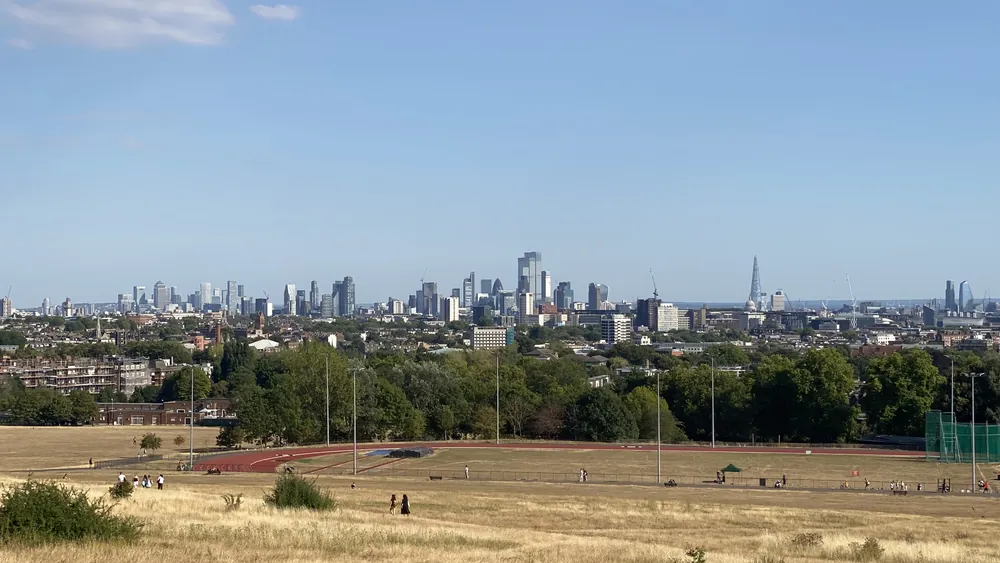
Every photo in this article was taken in late August 2026 by Joseph Blackwell ND Arb, arboricultural consultant at GraftinGardeners, on Hampstead Heath and in Alexandra Park and Barratt Gardens in north London.
A False Autumn in August
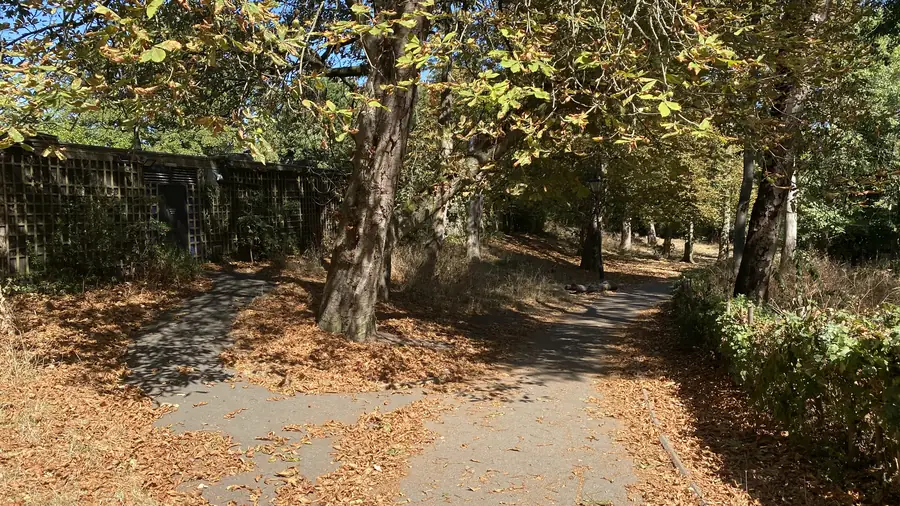
Walk through any London park right now and you will see it. Leaves crisping at the edges, whole crowns turning brown, and drifts of fallen leaves in what should be the greenest month of the year. Arborists call it a false autumn, and it is not the gentle wind-down of October. It is an emergency measure. A tree that cannot pull enough water from the soil starts shutting its leaves down early, shedding them, and sometimes aborting whole minor branches, all to cut its water demand and keep the trunk and roots alive.
A false autumn is not automatically fatal. Plenty of trees that dropped their leaves in the droughts of 2022 and 2025 leafed up normally the following spring. But it is an unmistakable signal that a tree is under serious stress, and stressed trees need watching, because the real problems tend to show up later.
Branches Falling on Still, Hot Days
Of everything a drought does to trees, this is the part that puts people at risk. Mature trees under severe water stress can shed large limbs suddenly, with little or no warning, and it usually happens on a hot, windless afternoon rather than in a storm. Arborists know it as summer branch drop, and reports across London rise sharply in summers like this one. It is now taken seriously enough that councils and park authorities have publicly warned visitors not to sit beneath large trees during the hottest spells, and staff in London’s Royal Parks have reportedly been discouraging it too.
The exact mechanics are still debated, but the pattern is consistent. It tends to affect large, mature broadleaves, particularly oak, beech, horse chestnut, willow and cedar, and the limbs that fail are often long, heavy, horizontal ones that look perfectly healthy from the ground. That last part is what makes it dangerous. There is frequently nothing an untrained eye would spot beforehand.
If a large, mature tree overhangs your garden, parking, a footpath or anywhere people gather, this summer is the right time to have it professionally inspected rather than next spring. A tree safety report documents the tree’s condition, flags any limbs or defects of concern, and gives you clear, prioritised recommendations, from £260.
The Warning Signs Worth Checking on Your Own Trees
You do not need to be an arborist to spot the early signals. Take ten minutes and look for:
- Scorched foliage, leaves browning from the edges inward, curling, or dropping while still green
- Early leaf fall concentrated on one side or in the upper crown
- Dieback at the branch tips, bare twig ends where there should be leaves
- Cracked, shrinking soil around the base, especially a visible gap opening between the ground and the root plate
- Fungal fruiting bodies, brackets or mushrooms appearing on the trunk, base or surface roots, which often follow a stressful summer
- A new lean or lifting ground on one side of the tree
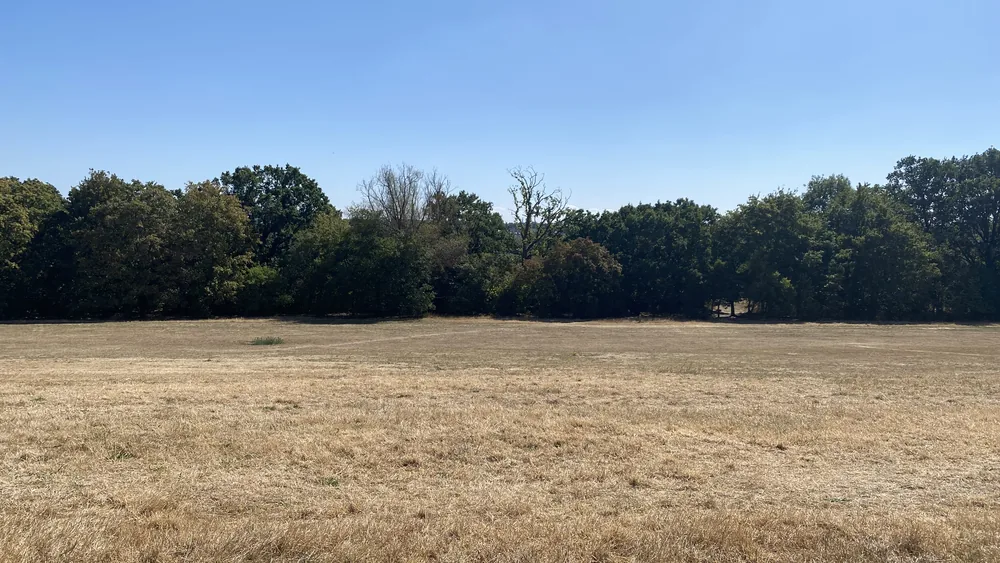
One of these on its own is rarely cause for alarm. Two or three together, on a large tree near people or property, is a tree that should be looked at properly. The photo below shows what to look for from a distance, a crown in Alexandra Park that has browned off completely while its neighbours are still green.
Young Trees Are Hit Hardest
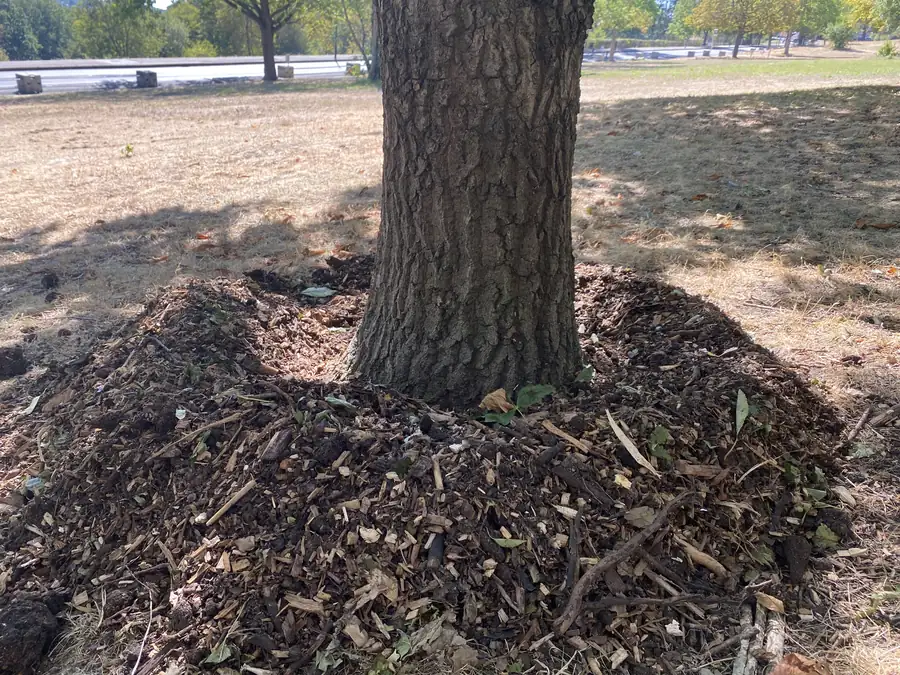
Saplings and anything planted within the last three years are the most likely casualties of this summer, because their roots simply do not reach deep enough to follow the water table down. The good news is they are also the easiest to save. A slow, deep soak once or twice a week does far more good than a daily sprinkle, and it is worth knowing that hosepipe bans generally still allow watering cans and stored rainwater, though you should check your own water company’s rules. A generous ring of chip mulch around the base, kept clear of the stem itself, helps the soil hold what moisture it gets, and you will notice London’s park teams doing exactly this to their own trees right now. Mature trees, by contrast, rarely benefit from watering. Their root systems are simply too large.
What Comes After the Drought
The rain will return. The risks will not leave with the drought, and some of the most serious ones only surface months later.
Pests and disease move in. A drought-weakened tree has lower natural defences, and organisms that a healthy tree shrugs off can take hold. Honey fungus, bark-boring beetles and a range of decay fungi all do their best work on stressed trees, and the signs often first appear the following autumn as fruiting bodies at the base.
London’s clay shrinks. Much of the capital sits on shrink-swell clay, and in a drought tree roots chase moisture deeper and further, drying the soil out and making it contract. That destabilises root plates, and it is also the mechanism behind the subsidence claims that spike after dry summers, which is worth knowing if a large tree stands close to your house. Several London boroughs have lost significant numbers of street trees to subsidence-related insurance claims after previous droughts.
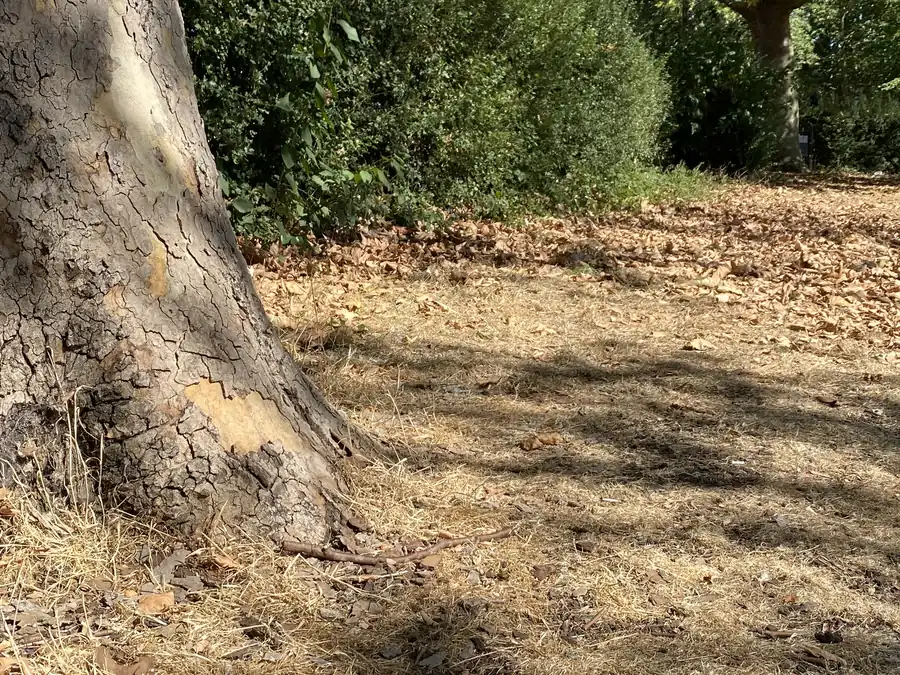
Autumn gales find the weakness. Parched soil pulls away from roots and loses its grip. When the first serious storms arrive in October and November, trees that survived the summer can fail at the roots, and the combination of a drought summer followed by a stormy autumn is exactly when we see the most storm damaged trees.
The damage stacks up. Last year’s drought ran for roughly six months before autumn rain broke it, and trees that had not fully recovered went into this summer already depleted. Consecutive dry years are why conservationists are now openly worried, with the Woodland Trust warning that England could lose half of its widest ancient oaks within 60 years.
What This Summer Means for Your Liability
If a tree on your land falls or drops a limb on a person, a parked car or a neighbour’s conservatory, the question that decides everything is a simple one. Can you show you took reasonable care of that tree? Under the Occupiers’ Liability Acts 1957 and 1984, the duty of care sits with whoever owns or occupies the land, and for workplaces, schools and public sites the Health and Safety at Work Act 1974 applies on top.
Here is why the 2026 drought may change the perception of liability. Courts and insurers judge negligence on what a reasonable owner should have foreseen. In an ordinary year, a hidden defect in an apparently healthy tree can be a real defence. In a summer when the drought has been officially declared across most of the UK, branch drop has been featured in the national news, and every tree on the street is visibly stressed, foreseeability becomes much harder to argue away. The owner with a recent written inspection on file is in a much stronger position, whatever happens next. The owner with nothing is carrying the risk personally.
For landlords, managing agents, schools and commercial sites, the bar is higher again. Regular inspection of trees over playgrounds, car parks and walkways is not just prudent but expected, and insurers increasingly ask to see the paperwork when a claim comes in.
Get Ahead of the Autumn
Defects are more likely to exist after a summer like this one, and the autumn storms that will test them are only weeks away. A professional inspection now, while problems are visible and there is still time to act, costs far less than dealing with the aftermath of a failure.
Our NPTC-qualified arborists prepare tree safety reports across every London borough, from £260, with clear written findings and impartial recommendations. We are strong believers in tree conservation, so where monitoring or light pruning is enough, that is exactly what your report will say. You can also explore our full range of tree surveying services.
Frequently Asked Questions
Why is my tree losing its leaves in August?
It is almost certainly drought stress rather than disease. Trees shed leaves early in dry summers to reduce their water demand, a phenomenon known as false autumn. Most trees recover the following spring, but a tree that also shows branch dieback, fungal growth or a new lean should be professionally inspected.
Should I water my trees during a hosepipe ban?
Newly planted trees and saplings, yes. Give them a slow, deep soak once or twice a week using a watering can or stored rainwater, which hosepipe bans generally permit, although be sure to check your water company’s rules. Mature trees rarely benefit from watering because their root systems are too large to reach.
Will my tree recover from drought stress?
Many do, especially after a single dry summer followed by a wet autumn and winter. Recovery is slower after consecutive dry years, and a stressed tree remains more vulnerable to pests and disease in the meantime. Watch it through next spring, and get advice if the crown fails to leaf up fully or fungal fruiting bodies appear.
Can a drought make a tree dangerous?
Yes, in three main ways. Water-stressed mature trees can shed large limbs suddenly in hot, still weather. Shrinking soil can destabilise the root plate. And drought-weakened roots in dried-out ground are more likely to fail when autumn storms arrive. If a large tree stands over people or property, a tree safety report will tell you where it stands.
Am I liable if my tree drops a branch during the drought?
You can be. Tree owners owe a duty of care under the Occupiers’ Liability Acts 1957 and 1984, and liability usually turns on whether the failure was foreseeable and whether the tree had been competently inspected. In a well-publicised drought, with branch drop widely reported, it is harder to argue a failure could not have been foreseen. A documented tree safety report is the strongest evidence of reasonable care.
Concerned about a tree after this summer? Call 0208 123 7653 or request a free, no-obligation quote. We cover every London borough and can usually get someone out to you within a few days.