Dangerous Sycamore Tree Made Safe at Wimbledon Congregational Church
- Date: 18/Nov/2026
- Comments: 0
On a Friday in the middle of September our team spent the day on the forecourt of Wimbledon Congregational Church in SW19, taking down a mature sycamore that had started to rot at the base. The tree stood a few metres from the pavement, the road junction and the church itself. By the evening it was down to a stump, the forecourt was swept and the stem sections were on their way to our yard. This is how the job went, with the video our videographer shot on the day.
The Dangerous Sycamore Project at a Glance
- Where: Wimbledon Congregational Church, Dundonald Road, Wimbledon, SW19, London Borough of Merton
- Tree: a mature sycamore (Acer pseudoplatanus) on the church forecourt, beside the pavement and the road
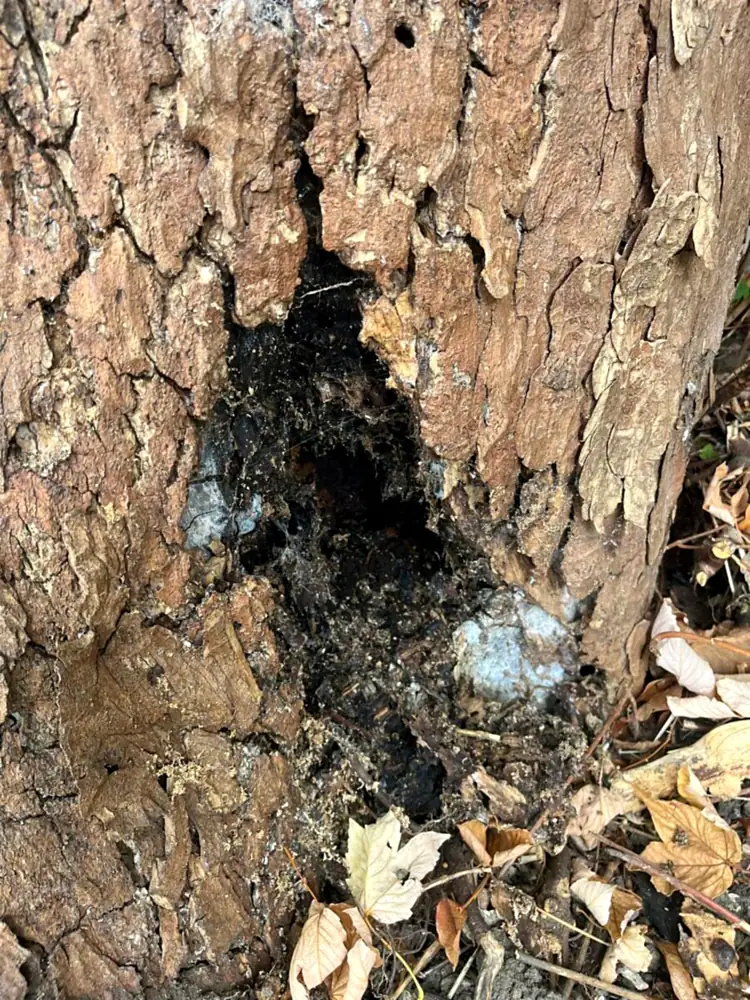
- Problem: two cavities at the base of the trunk with soft, decayed wood between them
- Work: sectional dismantle, felled to 1 ft above ground level
- Team: a climber, a lorry operator and ground operatives
- Time on site: one day
- Kit: our grab lorry, a wood chipper and climbing and rigging equipment
- Waste: brash chipped for biomass at our Surrey (Leatherhead) depot, stem sections to the same yard, nothing to landfill
Why the Tree Had to Come Down
Sycamore is a tough, fast-growing tree and most of the ones we look at in London are in reasonable health. This one was not. At the base of the trunk there were two separate cavities, and when we probed the wood between them it was soft. In a tree this size the lowest metre of trunk does all the work of holding the crown up and anchoring it against the wind, and that is exactly where this sycamore was weakest.
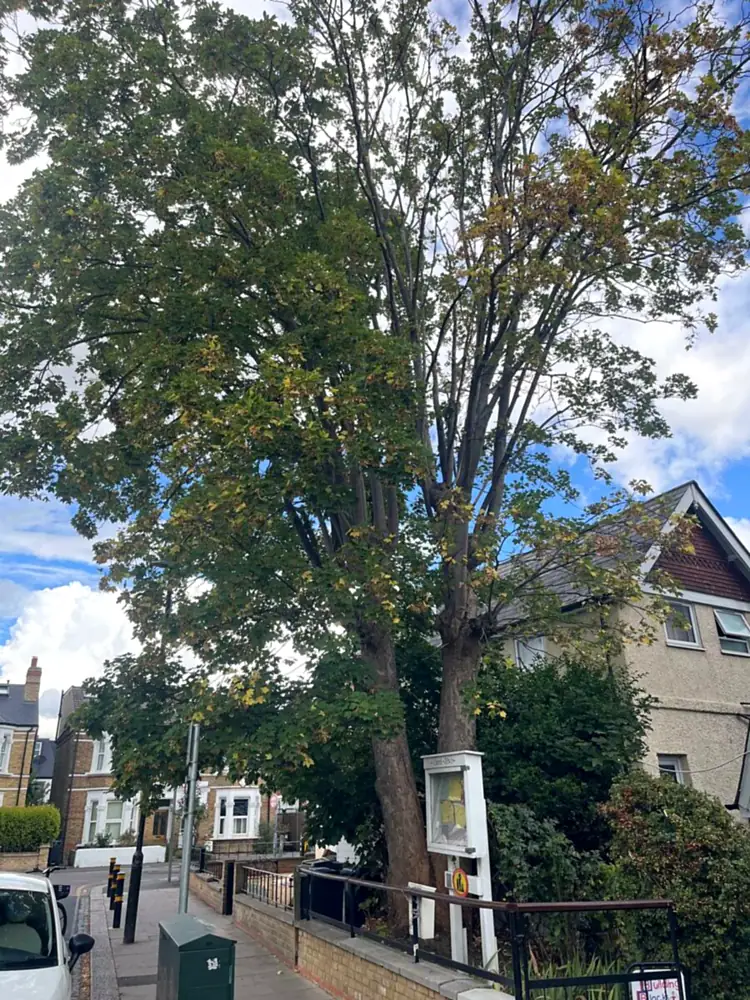
The crown gave nothing away. It was in full leaf and looked like any other street sycamore in September. That is the uncomfortable thing about basal decay: the part of the tree people notice looks fine, while the part they never look at is quietly losing its strength. Decay at the base does not get better, and a tree in that state can fail at the root plate in a gale or simply snap low on the trunk with no warning at all.
Where it stood settled the matter. The tree was on the church’s own forecourt, next to the pavement, with a road junction on one side and the building a few metres away. People walk past it all day, cars queue at the junction underneath it, and the congregation gathers beside it on a Sunday. A tree with a sound stem can carry a lot of risk in a spot like that. One with a rotten base cannot carry any. Felling it to a low stump took the risk out altogether, and the stump can be ground out later if the church decides to replant.
Letting the Council Know First
Before any work like this we check whether a tree has a Tree Preservation Order or stands in a conservation area, because either one means the council has to be involved before a saw is started. We notified Merton Council’s tree team before the work; they confirmed the tree was not protected and the work could go ahead. Had it been protected we would have handled the paperwork for the church, as we do on protected trees across Wimbledon and the rest of Merton. There is more on how that works on our conservation areas page.
Taking the Crown Down Over a Pavement and a Road
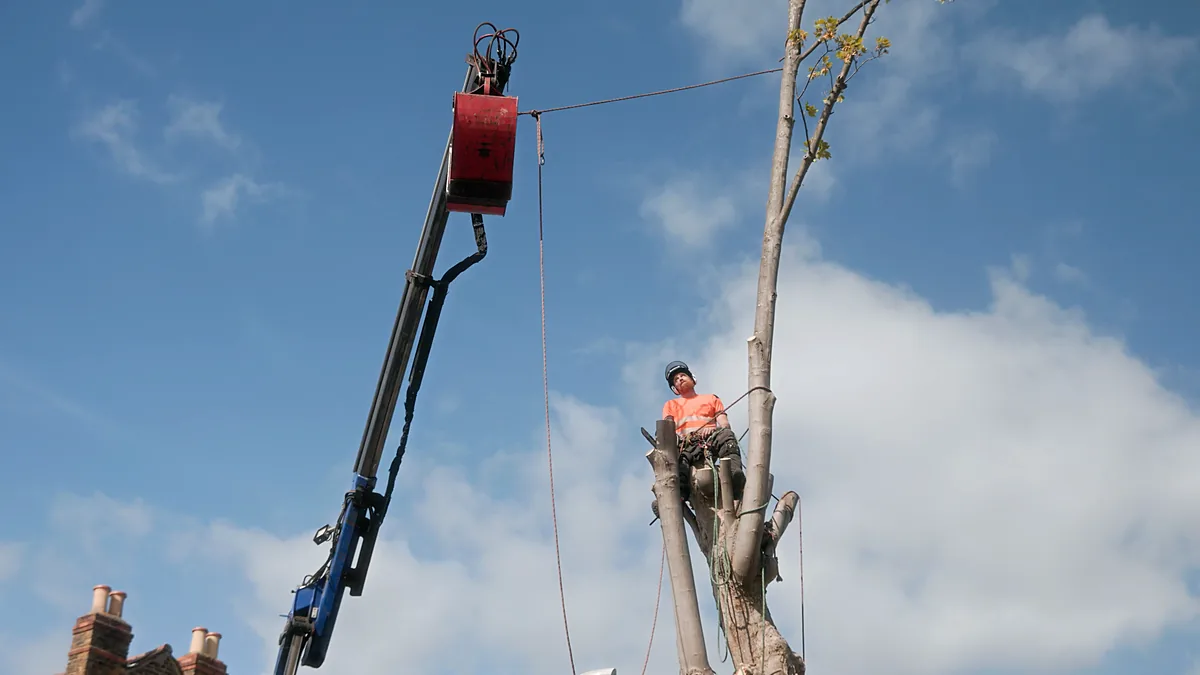
There was no question of felling this tree in one piece. The stem was rotten at the base, the only open ground was the road, and the crown spread over the pavement, the forecourt and the corner of the church. So the crown came down in sections. Our climber worked up through the tree on ropes, taking the limbs off from the outside in, with each piece dropped or lowered into the coned-off area below where the ground operatives could reach it. You can see the crown shrinking from the air at 0:51 in the video.
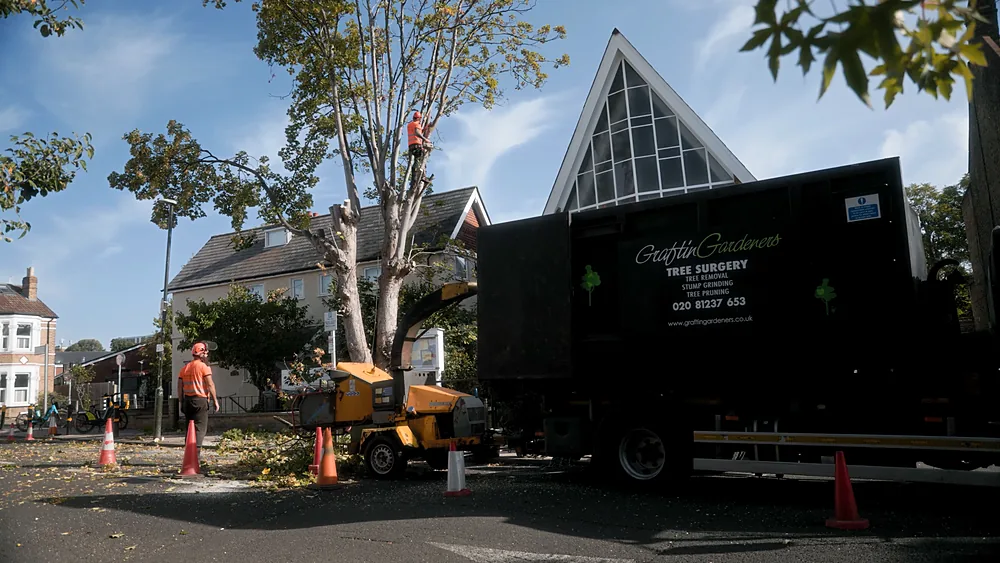
The pavement and the stretch of road beneath the tree were coned off for the day. Everything that came down was dragged straight to the chipper on the street, so brash never had the chance to build up on the forecourt. Once the crown was gone, the climber worked down the stem itself, cutting it into sections short enough to handle. By then the tree was down to a bare pole beside the church roof, which is the shot at 1:10.
Where the Grab Lorry Earned Its Keep
Sycamore stem sections are heavy, and a trunk this size would normally have to be cut into rings small enough to roll or carry. Here we had our grab lorry parked on the road beside the tree. Instead of ringing the stem down into pieces, the climber could cut longer sections and the lorry operator lifted each one straight off the tree and into the body, as you can see from 1:25 in the video. Fewer cuts for the climber, nothing heavy for the ground operatives to manhandle across the forecourt, and the timber went from standing tree to lorry body in a single movement.
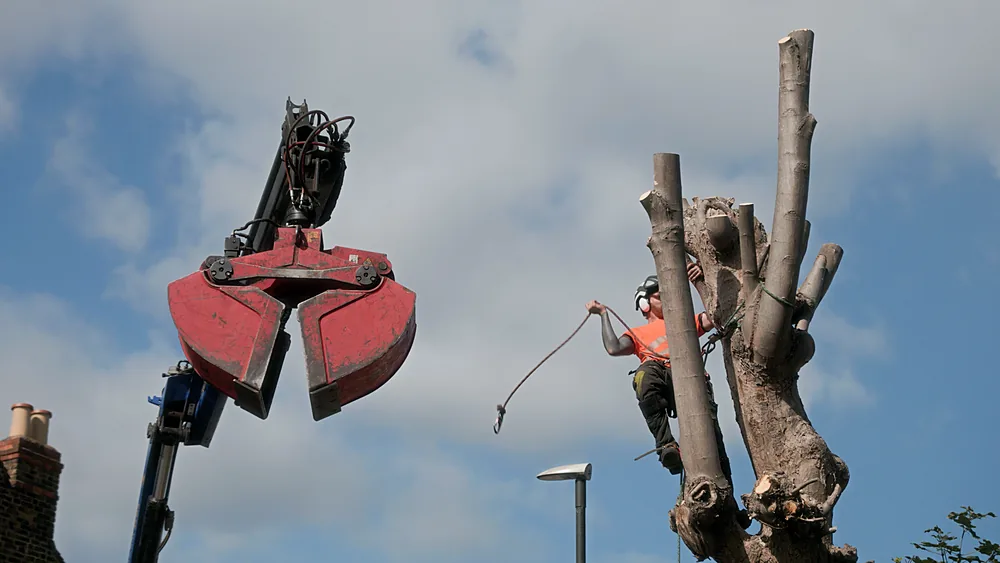
The last cut was made at about 1 ft above ground level, which leaves enough stump to grind out cleanly if the church decides it wants the ground back. That decision can wait; the dangerous part of the tree was gone by mid-afternoon. All of the work was carried out to our usual felling and dismantling standards under BS 3998:2010, the British Standard for tree work. A climber, a lorry operator and ground operatives, one day, and the forecourt was swept before the lorry left.
Where the Tree Went
Nothing from this job went to landfill. The brash was chipped on the street and taken to our green waste recycling centre in Surrey (Leatherhead), where the chip is dried into biomass wood chip. The stem sections went to the same yard on the grab lorry to be processed, so a tree that had to come out of a Wimbledon forecourt still ends up doing something useful.
The Result
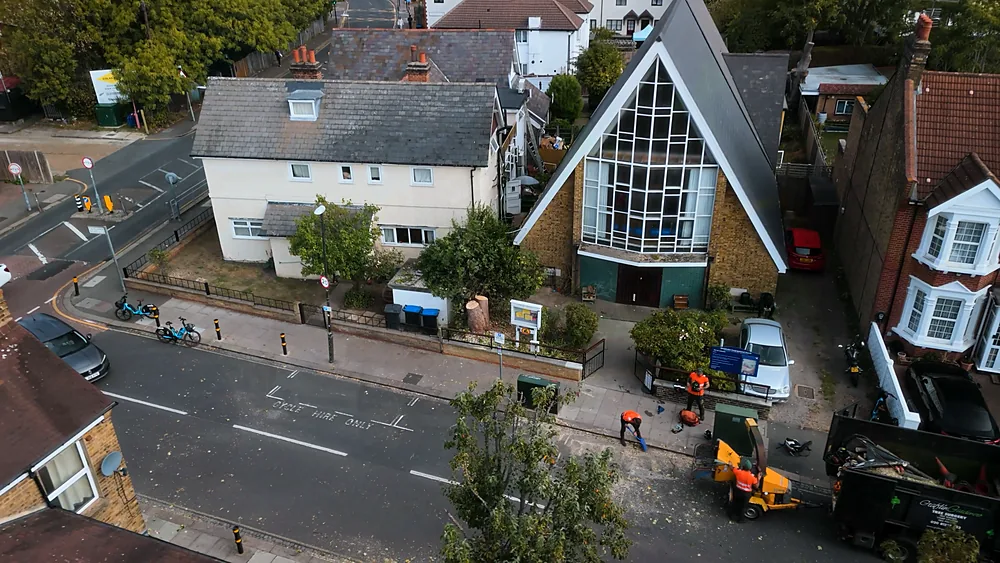
A clear forecourt, a pavement and junction with nothing rotten standing over them, and a church that no longer has to wonder what the next autumn storm will do to its tree. The job was finished in September, which is when we would rather be doing this kind of work: before the storm season arrives and a decayed tree makes the decision for you.
Responsible for Trees at a Church, School or Business Premises?
If you look after a site with mature trees beside a road or a footpath, the base of the trunk is the place to look. Cavities, soft or crumbling wood, fungal growth around the roots, or a fresh lean after wet weather all mean the tree needs a proper inspection rather than a glance from the car park. A tree safety report puts the condition of the tree and your options in writing, which is what a trustee, a governor or an insurer will want to see. If the tree does need to come down, we handle the whole job from the council check to the last sweep of the forecourt, as part of our commercial tree services.
We work across Wimbledon, Merton and the whole of London and Surrey as London tree surgeons with NPTC-qualified climbers, £10m public liability insurance and over 1,000 five-star reviews. Call 0208 123 7653 or request a free quote. You can also read how we dealt with a dangerous ash over five back gardens elsewhere in Wimbledon the same week.
Frequently Asked Questions
How do you know when decay at the base of a tree is serious?
The warning signs are cavities or holes at the base of the trunk, wood that is soft or crumbles when probed, fungal brackets or mushrooms growing from the trunk or the roots, and bark that is loose or sunken. Any of these in a large tree beside a road, a path or a building needs an inspection by a qualified arborist. The sycamore at Wimbledon Congregational Church had two cavities with soft wood between them, which is why it was felled.
Can a decaying sycamore be saved by pruning it?
Sometimes a crown reduction can take enough weight and wind load off a tree with limited decay to keep it standing safely for years. It depends on how much sound wood is left, where the decay is and what the tree stands over. Where the decay is at the base, next to a road and a public building, there is usually not enough margin to make that worthwhile, and removal is the responsible option.
Do you need permission to fell a tree on church grounds?
Only if the tree is protected by a Tree Preservation Order or stands in a conservation area, in which case the council must be notified or an application made before the work. We check this with the local council before every job and handle the paperwork where it is needed. Some denominations also have their own approval process for works on church grounds, so it is worth checking with the church’s governing body too.
Why use a grab lorry to remove a tree?
A grab lorry lets the climber cut a trunk into longer, heavier sections instead of many small rings, because the crane lifts each section straight into the lorry body. That means fewer cuts, less time for the climber in the tree, nothing heavy to carry by hand and no stack of timber left on site. It needs the lorry to be parked within reach of the tree, which is why it suits roadside trees like this one.
How long does it take to fell a large sycamore beside a road?
With a climber, a lorry operator and ground operatives, a mature sycamore like this one is a one-day job. The crown is dismantled in sections through the morning, the stem comes down in the afternoon and the chip and timber leave on the lorry the same day. Larger trees, tighter access or a tree that cannot be reached by a lorry can add a second day.
Article was written by Adam Rybinski · Company Director · GraftinGardeners Ltd · Published November 2026
Article Source: https://www.graftingardeners.co.uk/dangerous-sycamore-tree-wimbledon/